

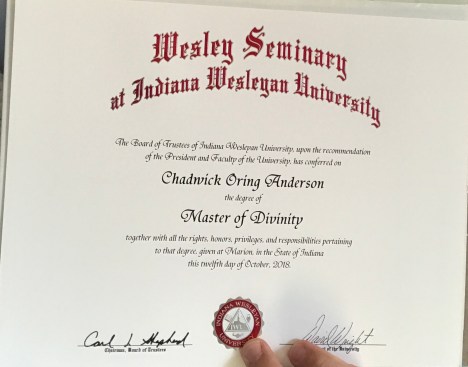
The “official” graduation ceremony for my MDIV takes place this Saturday. I’ve already walked (across our home church stage, to receive my diploma from my wife & children), but I figured this would be a good moment to pause. Here are a few words I wrote many months ago, toward the end of my MDIV. These are words I want to look back on and remind myself with, and so I “file them” publicly here – in case they may serve to encourage others. These are not profoundly unthought of, will not shock the world, or inherently transform someone’s ministry. But for me – they are important to remember:
PERSONAL MINISTRY STATEMENT
“My life in ministry aims to join the incarnational presence of Jesus by living out the good news of the gospel invitationally in every area of my life toward the New Creation of all things – both now and yet to come.”
Based on the coursework at Wesley Seminary, the reminders and wisdom gained, the time spent in scriptural study, and conversation with others – I can say some foundational things about ministry itself. I would use the word “pastoral” ministry, but this may imply that it is only true when serving as a professional “pastor”. Instead, I would simply use the term “Ministry” itself from the Christian perspective. This implies and includes those descriptions of a pastor but does not limit an understanding to someone who is paid to carry such a title professionally. Such ministry must always be incarnational, invitational, and eschatological.
INCARNATIONAL
In Jesus we see God becoming human to literally make this fleshly world the location of His presence in a way that had never occurred. This was not simply to give us a pattern to emulate, but by his resurrection and Holy Spirit becomes something we’re empowered to participate in. Any effort for ministry must be fed by first feasting at the table set for us by Jesus in prayer, Word, and worship. By receiving New Life in Christ, we are transformed into that New Creation that proclaims Jesus as fully Lord here and now. This means we are not simply incarnational to be among the people God loves, but we are missionally incarnational – infinitely compelled by the Love of God to proclaim, live out, and share the reality of God’s New Creation reality as is arriving “on earth as it is in Heaven.” Christian ministry here will be a response to all of this in the context of bringing healing restoration and redemption to relationships between humanity, God, and creation itself.
INVITATIONAL
In Jesus we see God extending such an invitation not only during a worshipful moment in the temple but as he walked along the road. We see Jesus extending the invitation to not only hear the objective truth, but to live in the new reality of all things transformed by Christ – set free from both sin, and the death it brings about. Christian ministry contains all of the amazing “Means of Grace” talked about by John Wesley, along with the “Method-ism” he espoused but is so much more than these things. It happens as Deuteronomy 6 proclaims, “When you sit at home, and when you walk along the road, when you lie down, and when you get up.” Because of Jesus Christ, there is no person, no group, no location, no family, and no brokenness that is beyond the invitation of God to experience freedom and redemption in His Love. Christian ministry here is empowered by the Holy Spirit to extend that invitation in life and word.
ESCHATOLOGICAL
In Jesus, we see a life and ministry that joins the flow of God from something toward all things being made new. Even as important things happen, especially in the context of individuals and communities, it is always within the larger context of the Kingdom coming fully that these things are located. The word here is generally used for “last/final things”, but in this case, we really view the coming “completion of all things” as a New beginning that is forever located fully within the reign and rule of Christ. Christian ministry here recognizes with both hope and humility that everything we do, say, and any bit of our “being” is to be discovered and understood within those purposes and activities of God toward what will be. That is not to say our eyes are completely turned toward the “final days”, or even to a contemporary understanding, as we believe God has been speaking and revealing His final purposes actively as His Love has been transforming all things since creation itself.
CONCLUSION
There are libraries filled with books about how these things find themselves happening and “fleshed out” in the midst of individuals, families, and communities shaped by the loving presence of Jesus Christ. It involves worship services, small groups, proclamation, Bible studies, accountability, prayer, fasting, baptism, teaching, and more. Depending on the particular situation, season, and lives involved, it may take different shapes. But at the core, Christian ministry is always about joining the work and life of the Triune God who has invited us to do so in ways that transform us for the sake of all creation. We do this in fear and trembling, with excitement and joy, and mostly with a whole lot of grace – offered first on our behalf, so that we might begin to respond as He calls.







 attempts at this are found in Genesis 3:7, as Adam and Eve sew fig leaves together out of a desire to cover up their true “self” which they’re shamefully aware has been marred. They want to be perceived without the humiliating nakedness and vulnerability, and so they put on leaves and say, “This is the image I’ve chosen to represent the ‘self’ I’m curating for you to perceive me as.”
 words from wick