
Posted in Uncategorized

SHOCKING TRUTH that ALL remaining candidates have in common…

As the pack of candidates thin out, more investigations were made possible.  CIA, and FBI, and MI-6 all have these candidates on their radar, and yet each of them might still be unaware of the shocking truth being revealed today.  Ready for the bombshell?

Each of these candidates is beloved by God.

Gasp.  I know.  It’s true.  They each find themselves shoulder to shoulder with those God has smiled on, and loved enough to enable to bear pointingHis image.  That has important implications for how we are to respond to each of them, and how we might also need to repent of how we’ve responded so far.  The fact is, most political races end up having ugly moments.  A few bits of name calling, and an accusatory tone here and there.  But let’s confess – no matter who you’ve supported or disavowed – this race has not brought out the best in us.

 

Read the words of 1 John chapter 4, and you’ll quickly be reminded that one of the marks of the church was their love.  The response to what is happening in our world is not fear or anxiety, but love.  It is not anger or retributive violence in action or word – but love that will help us to stand out as God’s “image bearers”.

Does this mean we have to embrace all possible leadership candidates with flowers in our hair, and let anyone take the oath who might be interested?  No.

But it does mean we are careful with our words and actions (and retweets).  It means even as we examine policies, determine who might best lead us forward, and discuss these things with others – we are careful to realize even as we critique the lives of others, our lives are being noticed by a world who wonders “Does Jesus make any difference in the lives of those who claim Him?”  The answer should obviously be – YES!

How often have we genuinely prayed for the candidates we disagree with?  Each of these brothers and sisters of ours is under extreme pressure and in a national spotlight.  With very little regard for personal privacy, and with every word they speak or write being critiqued and examined under a thousand unloving microscopes – they need our prayers.  These are mothers, fathers, and grandparents who have entire families who celebrate with their victories, and mourn with their losses.  No matter what happens in 2016 – each of these will go on to laugh and smile at children’s birthday parties, and shed tears at funerals of loved ones.  May we not buy the rhetoric that reduces ANY of them to a 2-dimensional caricature, in an attempt to make it easier to treat/view/speak of them as less than someone loved and valued by God.

1 John 4:20 – “Those who say ‘I love God’, and hate their brothers or sisters are liars; for those who do not love a brother or sister whom they have seen, cannot love God whom they have not seen.”

Luke 6:27 – “But I say to you who hear, Love your enemies, do good to those who hate you.”

Ephesians 4:29 – “Do not let any unwholesome talk come out of your mouths (or typed/liked/retweeted by your fingers), but only what is helpful for building others up according to their needs, that it may benefit those who listen.”

Of course, the list here could go on – especially highlighting the life and words of Jesus himself.  As we continue forward on our journey through Lent this year, we are offered an opportunity here.  May we choose to respond humbly, repenting of how we might have misrepresented the love of God, and offer ourselves to bear His image anew…


ps. If your first inclination is to defend unloving words, citing scriptures where God or Jesus showed their anger/disapproval – you may be missing my point.
 

Posted in Adoption Journey, Different Moments, Different Scriptures

Oh, be quiet Larry…

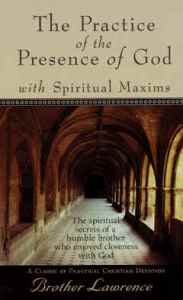
I remember back in late high school or early college:  There was this short Christian classic on sale or clearance or something and I wanted to get it.  A small part actually wanting to be the kind of person to read such books, and a larger part wanting to seem to be the kind of person to read such books, I snagged it.  I read through it a bit.  I smiled.  I even understood a few sentences.

In college, it was mentioned here and there.  I knew the topic vaguely, and smiled and nodded whenever someone mentioned it in conversation.  Yes, that is quite a good book.  Yes, I do so enjoy practicing the presence of God, just like Brother Lawrence did in “Practicing the Presence of God”.  Whether doing the dishes (as he did) or other menial tasks that my day to day existence brings me, I love the fact that Christ always offers to be very near.  God truly is with us, closer than we often realize.

I was a bit surprised then, when reading the book more closely for my current course on Spiritual Formation, to find so larrymuch in the book I didn’t like.  When the author writes Brother Lawrence (let’s call him Larry) to tell him of a friend who loses a close friend to death, Larry tells him to advise his friend to use these moments to his advantage.  “What a great opportunity to give the part of your heart previously given to your friend back to God where it belongs!”, he seems to say.  Or when the author himself is aging and enduring intense suffering of some sort, Larry refuses to pray his suffering would be taken away.  Instead, Larry insists on praying that God would strengthen the author to endure the suffering that is most likely God’s way of refining his heart and soul.  No, I do not like this guy much at all.  I don’t think I would have written him as much as the author seemed to.  A man who neurotically spent at least 10 years of his life anxious that he shouldn’t be distracted in thought or feeling by anything that might take God’s place, finally ending up with peace (albeit alone, and without much pleasure it would seem beyond the “presence of God”).  No, I do not like this guy much at all.

Yet…I can appreciate his heart.  A heart that yearns for the presence of God so much that everything else – even the extremely important things in life – melt away.  An experience of God’s presence, even in suffering alone, that gives him a sense of complete and udder wholeness that so many empty people in our world are hungry for.

I’ll admit, wrestling with his message comes at a poignant time.  Last week was the final week of Lent.  The season of preparing for Easter.  It was also a week of waiting for an important update in terms of our adoption.  This journey that has taken over 3 years, it finally feels like our boat has spotted land.  So it takes a bit of humility to confess that I, a pastor who was allowed to even baptize several people this morning, was distracted most of my week by checking my e-mail for an update that never came.  That dotting my week of anticipating the resurrection of Jesus Christ, I was experiencing the brokenness of a human whose heart is not at complete peace in this broken world.

Part of me realizes that’s probably okay.   Jesus was certainly not often “at peace” in this world.  Another part of me realizes, there’s something to all this stuff Larry was talking about.

But before you or I go out and leave our family, secluding ourselves in monasteries away from our spouses and children, aiming to live like Larry and push away anything that threatens to occupy a place in our hearts – I don’t think that is required.   But we can be reminded in powerful ways, the truths found in Scriptures like 1 Corinthians 15.  That Jesus died and was resurrected.  The truth of this powerful statement impacts us as individuals, and puts every anxious thought, every deep-seated need/emotion, and every well-intentioned prayer in a wonderfully redemptive context.

The Truth of a resurrected Jesus Christ releases us from serving the state of our situations.  Even though there are times (like this past week, and probably again in the future) we don’t want to hear it, the words of Brother Lawrence come as important reminders: Even really important and good things are not “foundational” the way Christ and His resurrection are.  We can have Peace, even in the midst of needing peace.  That is something the world considers foolish.   That is something scripture considers faith.

That is something my daughters need from their father.  Something my wife needs from her husband.  And so, not as an individual but as a family – we work to shape our heart to seek pleasure only in the things that please God.  We seek to walk with Him as the center of our being.  We confess that this is not an easy road, and we sometimes lose focus.  But we return to this walk and practice – together.

(and really really pray that our boat would draw a big step closer to “land” this week) 🙂

Posted in Uncategorized

A new perspective on the “Good Samaritan”

In Luke chapter 10, an expert in the law stands up to ask Jesus a question. The purpose of the original question seems to be in “testing Jesus”. It may be that he wants to reveal Jesus as a false prophet. By asking “What must I do to inherit eternal life?”, it’s possible he was trying to catch Jesus in saying that something other than being a Jew can lead us into being a “child of God”, and thus worthy of the inheritance. We know that a lot of people were trying to catch Jesus in a moment of blasphemy against the Law, and yet in true Jesus fashion – He totally turns the tables.

With impressive rhetoric, Jesus asks the man a question in response, “What is written in the law?” The man answers proudly with his knowledge, and as Jesus pats him on the head in verse 28 the man remembers his original intent. Still wanting to test Jesus, and justify his original question, he asks for clarification, “And who is my neighbor?”

In response this time, Jesus tells the story we know as “The Good Samaritan.” He closes by tying the story to the original question by the expert in the law. Earlier it was stated, “Love your neighbor as yourself.” Here we have Jesus pointing out that the assumed definition of “Neighbor” (any member of the Hebrew nation/commonwealth) fell short of this new movement the followers of Christ were proclaiming. Here, the main character we assume was a Jew (heading from Jerusalem to Jericho seems to point that way). The character in the story who had the most in common with him in regards to loving (Luke 10:27) ends up being the Samaritan. Even though there was a long history of tension and conflict between their people (and remains still today), Jesus is pointing out there is a grouping of people that goes beyond national boundaries or allegiance to human leaders. There is a foundational difference in the hearts of those who are living from the Love of God. This brings us together beyond any worldly division of culture or ethnicity. It melts away any prejudice we may have, for the purposes of God’s Love, mercy, and compassion.


Now, maybe the Samaritan knew this was a Jew. Scripture tells us he was “attacked by robbers…stripped him of his clothes, beat him and went away, leaving him half dead.” Maybe there were torn clothes nearby, or he noticed the man was circumcised (if he was naked). But it’s also possible the Samaritan was simply doing what he would do for anyone, whether friend, brother, or enemy of his people. His citizenship was in the Kingdom of God, which means that he was someone for whom “Love” was his native language. Love for all.

So was Jesus challenging the expert in the law to love “like” the Samaritan, showing mercy and compassion to even those who are broken, bleeding, and lying in the street? Or was Jesus challenging the expert in the law to admit that even here, in the people of Samaria, there can be those who are understanding what this Kingdom of God’s Love looks like?

It sure seems like the latter. Jesus was pulling back the curtain, opening the shades, and clarifying the unexpected Truth for this expert in the law – there may be more invited to this “who’s in?” party than you originally thought.

What are the implications here for us?

There are many, but here are a few thoughts: The Samaritan was so motivated by Love, he wasn’t worried about the terms of this world. Whether touching the man on the street would make him unclean or not, or whether they agreed politically or not, were not important issues. He was motivated first by Love. The opposite seems true of this political expert, who seems to try and catch Jesus in a moment of heresy. He has been living according to “who’s in” and “who’s out” for so long, he wanted to help catch Jesus off guard. But the heart of God is not stuck in the patterns and molds we like to form equations by. We cannot reduce becoming a child of God to a stamp of approval, a “sinners prayer”, or a purity ring. By doing so, we fail to love our neighbors who may already know more about actual Love than we do.

This story invites us to let go of sitting in a room deciding what we can do to be people who are “in”, and go out into a world of hungry, beaten, slaves to proclaim freedom, resurrection life, and sustenance. As Bob Goff has written, “Love Does”.

So how does this story offer to challenge our local churches? I think most of our local churches would be quick to tell you how much love God has for the poor. They know God loves the broken, the drug-addicted, and the alcoholic just released from prison. They’ll welcome them any day of the week, and proclaim God’s Love. The challenge in this story might be a bit harder to pinpoint, and might vary from family to family. Decatur is a city with quite a few ethnicities, cultures, and religions. It would be a pretty big “zing” for our people to admit some of these people who know nothing about Christ might in fact be living with more love for others. So what is it about our practices, our unspoken rules, and the ways we do church….are keeping us from existing and being known from our love for all others?