
Posted in Different Scriptures, Different Thoughts

powerfully weak.

In prayer with my friend and pastor this morning, we were challenged by these words of A.W. Tozer: “Part of the successful operation of that (unhealthy) church depends upon (those) with business talents and part of it depends upon (those) with natural gifts as salesman and politicians. I say that a Christian congregation can survive and often appear to prosper in the community by the exercise of human talent and without any touch from the Holy Spirit! All that religious activity and the dear people will not know anything better until the great and terrible day when our self-employed talents are burned with fire and only that which was wrought by the Holy Ghost will stand forever! Through His Spirit, God is waiting and willing to do for us or for any church what He waits to do for the entire Body of Christ!

It is a generous mystery, this dichotomy we’re invited to enter into.

On one hand, God has given us each gifts for ministry to be used for His Kingdom. If you’ve never discovered what yours could be, check out this easy test that highlights the 5 primary ways Jesus has gifted people to serve the Church. It’s good for us to discover where all our strengths are, and to be faithful stewards of the gifts God has given us. Part of the important work we do as a church is helping each person to discover how they’re gifted, and how they can join the Kingdom of God being revealed, proclaimed, and experienced. I also believe each of our homes, and each of our local congregations are gifted and shaped in particular ways to reflect and offer the healing presence of Jesus to our neighbors and our communities/world.

On the other hand, we have examples in both scripture and real life where people proclaim/experience God using their weakest areas in order to bring Him glory and do transformational work for the Kingdom. Where we are weak, we are forced to depend completely on the Holy Spirit for empowerment, instead of getting by on our own natural talents/abilities. As Paul writes to the church in Corinth: “But he said to me, “My grace is sufficient for you, for my power is made perfect in weakness.” Therefore I will boast all the more gladly about my weaknesses, so that Christ’s power may rest on me. 10 That is why, for Christ’s sake, I delight in weaknesses, in insults, in hardships, in persecutions, in difficulties. For when I am weak, then I am strong. (2 Corinthians 12:9-10)

So what should we do? Perhaps we could have a season of investigating our weaknesses, and invite everyone to serve only in those areas to ensure we’re always depending on the empowerment of the Holy Spirit to arrive? Obviously not.

But we can purposefully seek practices of humility that invite us to both confess our desperate need for God, while offering our brokenness to God in ways that invite His perspective and redemptive use for the Kingdom. We should regularly be seeking ways to empower others and listening for God through them, instead of assuming God only wants to do what He has done through those He has already used. We should be willing to invite new people into service in ways that offer grace to experimenting with new skills – as a way of affirming our dependence on the One who must be our foundation and guide.

One thing the pandemic offered us, was a chance to strip back all the “extras”, and examine why we do what we do. Many have already lamented that the church, anxious to return to what was, may have missed an invitation and opportunity to be revived in ways we cannot on our own strength. What are the foundations of who we are, and what we’re seeking to accomplish as we gather, and as we are being sent out each week? Perhaps it’s good for us to completely “unplug” or “re-arrange” what seem to be our natural talents/resources on a regular basis – to light a candle, pause in silence, and orient ourselves in the presence of a God who promises He will always be found by those who seek.

What might that look like in your life today?

What might it look like if we sought such empowerment together, confessing by prayer and fasting that our own appetites and abilities to feed them will never reach that which God pours out freely?

Posted in Different Scriptures, Uncategorized

submitting to Freedom

In reading of Paul and Silas in jail recently (from Acts 16), I was drawn to pay attention to part of the story happening in the background. The narrative we often celebrate are Paul and Silas, in chains and imprisoned right after being stripped/beaten/flogged. In the midst of singing hymns to God (v. 25), a violent earthquake shakes the foundations so that all the doors are opened and chains unfastened. What a miracle! The jailer enters the scene assuming the worst, and is thankful to discover Paul and Silas and the others are all still there! He’s drawn to Jesus, becomes a believer, and his entire family is baptized as they enter this new community of “The Way”. The story continues forward after that.

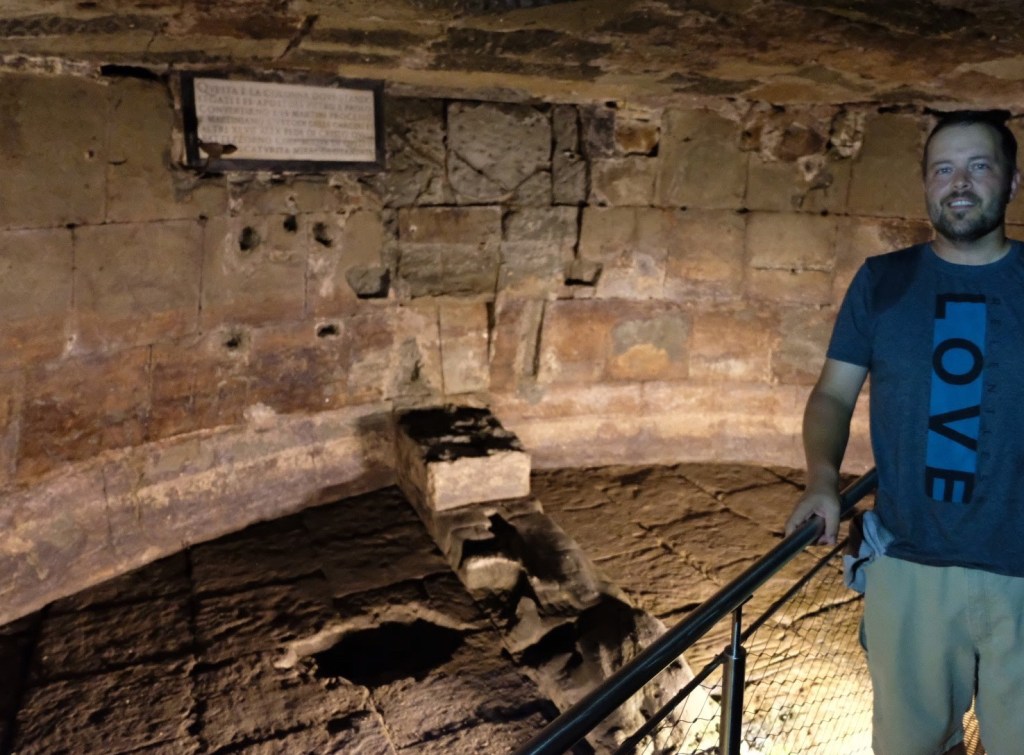
Mamertine Prison, Rome – Just one of the places Paul spent time imprisoned

But looking back over those moments there’s a story within, we often overlook. There in that prison were other prisoners, even though we’re not sure their number or the crimes they committed. We can assume there are some in the prison who deserve to be there. Yet when the earthquake happens and the chains and doors are unfastened – everyone remains. Why might that be?

For that answer, we look back to verse 25, “About midnight Paul and Silas were praying and singing hymns to God, and the prisoners were listening to them.

I remember sitting in the waiting area of a doctor’s office on our honeymoon (we both had tonsillitis, yuck). As I waited for Sarah, I met an older man and we began to talk. He had served the country in combat, and was telling me a story of his escape from a POW camp in Germany. I didn’t know him that well, but I was riveted. I would have listened for hours.

I imagine the fellow prisoners surrounding Paul and Silas, seeing them beaten and suffering. I imagine their countenance as they entered the prison – genuinely thankful for new witnesses to share the good news with. The compassion they may have looked upon the other inmates with, even through swollen eyes. The whispers of “Have you heard??…” as rumors swirled about all the things these followers of Jesus had seen and experienced. Stories were shared, no doubt: Paul’s vision of Jesus, and work with so many churches. Silas’ prophetic words for those in the prison. The conversion of the local woman, Lydia. The other prisoners would have been transformed in hearing about Jesus, and in listening to the worship being offered in such a low place of pain and suffering. It’s a testimony to the the Holy Spirit we believe is active in these moments.

I believe the other prisoners were transformed by the witness of Paul and Silas, in ways that made them so aware of freedom in Christ, the chains and doors being unfastened seemed to make little difference to their present condition. They had already been set free in Jesus.

We’re reminded by all of these things – to be those who are willing to share our stories of God working in our lives. Speak of the hope and the peace you have, even as one who is looking honestly at our world; as one who has wounds from being hurt by it. Those around you today may have chains of bondage you’re completely unaware of, and you are able to offer freedom simply by sharing the living presence and Love of Jesus in Your words.

We’re also reminded – the story of who becomes transformed by our words may never be shared. Our world often celebrates the most compelling (or most profitable) narratives, but leaves many to be known only by those who live them. That doesn’t make such stories less important to the Kingdom. Every one of those prisoners who came to know Jesus is just as precious to God as the jailer, or Paul and Silas themselves. In fact, in the stories written down or passed on to their families and loved ones – the fact that they remained in prison that night instead of escaping -offered powerful testimony that revealed the absolute freedom Jesus offers.

Maybe that’s the message you need today also – even more than other aspects of the story. You need reminded of the Freedom we have when we come and submit all of our identity, our story, our shame, our hurts, and our joys to Jesus. It’s a freedom that transcends the momentary/temporal experiences we face. The peace of full submission to His Loving Freedom is so much more powerful than the temptation to run when we see an open door.

May we be challenged by all of this today in healthy ways. In a world that counts pageviews, book deals, and followers/subscribers, may we humbly and gladly submit our stories to being “His” story, revealing and responding to Love wherever and however we can. May we relate to all others today understanding that in life there are no “major/minor characters”, as all have become part of His redemptive narrative of Love.

Posted in Different Scriptures, Uncategorized

the waters…

Matthew 14:22-33 doesn’t seem like a “Baptism Passage”. But as it involves Jesus, water, and our relationship to them, it spoke to me recently. The disciples are out on the water, in the middle of the night, being tossed in some waves. I know there are many of us who love being out on the water. Many of these men were fishermen, who were very comfortable on the water – and they were used to being out there all hours of day and night.

Yet as comfortable as they were on the water, as we read of Peter’s fear in verse 30, we realize there is still a sense of fear involved in the uncontrollable forces of nature. Throughout scripture, there is something important that happens to water from Genesis to Revelation…and this moment is just one of those transformational moments.

In Genesis 1:2, we read “Now the earth was formless and empty, darkness was over the surface of the deep, and the Spirit of God was hovering over the waters.

There wasn’t much yet, except what God had brought into being. The Spirit of God hovered over the waters of chaos and formless-ness. We see water being symbolic of mysteries, even death, and sources of fear and unknown. We see this in the stories of Noah and the floods, or as the parted waters return to vanquish the armies of Pharaoh in the story of Exodus.

But listen to what happens to our relationship with water by the time our story with God reaches Revelation 22, “Then the angel showed me the river of the water of life, bright as crystal, flowing from the throne of God and of the Lamb 2through the middle of the street of the city. On either side of the river is the tree of life* with its twelve kinds of fruit, producing its fruit each month; and the leaves of the tree are for the healing of the nations.

Let that reality sink in for a moment. How wonderful and hope-filling does that sound? But here in today’s scripture, and here in today’s broken world of 2022, we are not there yet. We live as a community in a way that proclaims the incoming of that future reality. In moments of Baptism, we join with Peter and Jesus, transforming our relationship to the waters.

First – Jesus enters the scene as someone who is able to walk on the waters.

Think about the sources of chaos, fear, mystery, and all the things you can’t control. The things in your life that you wish you could overcome, and “walk over” in ways that they have no power over you. We look to Jesus, walking on the water, and we are filled with hope. We join Peter in calling out – “Let me join you.” Jesus extends a hand to us, and says “Come.”

But as we look at Jesus, we see not only His Lordship, but also His sacrificial Love. We realize that even though Jesus could have “walked on water” his entire life, he didn’t. He purposefully dove under the surface of our human experience, allowing the waters to overtake him with everything they could.

The Second thing I see – Jesus, who could walk on the waters – chose to enter into them. Literally, he was baptized by John. But also figuratively – in the compassion of God, he chose to “suffer with” us, as one who felt the pain and brokenness of living within a world impacted by sin. He experienced the worst of what this world offers, and was even put to death in one of the most shameful ways that existed…and then rose again, victorious over all of these forces.

The Third thing I want to point out – is that this Jesus who walked on water, yet chose to enter the waters – is the same Jesus who says “follow me”. He doesn’t say it to you individually – he says it to each of us together as a body also. “Church – follow me.”

There is so much symbolism in baptism, but it’s important for us to know these moments were always about community, and becoming part of the body of Jesus. It’s the path toward entering into the local community of the body of Christ in a tangible way. We enter through the waters of “dying to our self”, and “coming alive in Jesus”. We give up our identities, and the claims we had to becoming whatever it was we previously wanted for our own sake. We often do this for our children also, when we have them baptized at younger ages, saying “This is the identity of our family.

We become literally “The people who have passed through the water.” We enter into that which used to symbolize mysterious forces of death, chaos, and formlessness…trusting that we will emerge as New Creations on the other side. The waters of death have become the waters of cleansing & New Life. We lay down our lives, relinquishing all things, for the sake of coming alive as God’s Flesh. When we take our first breath after coming up for air, we are like newborn babies gasping for breath for the first time. No longer our own, we are now part of this community of those who have died to self.

Some of this sounds so desirable, even those of us who were baptized long ago may think to ourselves, “Man, it’s been a while and I’ve sinned since then – I want to go through it again.” To those of us having these thoughts, I want to encourage you – there’s no need.

When you come alive as those “New Creations” who have entered the community of believers, we have joined with Jesus who has conquered and brought freedom from all sin. Just like welcoming someone to a “Surprise Party”, it’s fun to watch them enter and yell “Surprise!”, but the point is the banquet and celebration itself. We are now a community where forgiveness reigns. Where reconciliation and redemption are our native language. Where shame has no power, because we are all in need of God’s grace.

Here among us, the waters no longer represent death because death has no power.

(Let the Church be a living “Amen”.)