Posted in Different Moments, Different Scriptures

taking a walk…

Last week I was able to spend a good portion of a work day in quiet prayer and contemplation. I spoke with God, and He shared from His heart for me. It was a refreshing time in His creation, and my thoughts were slowed/simplified in His presence.


I remember learning about the “sacred pathways” highlighted by Gary Thomas many years ago. (Pause to take the survey now if you’ve never done so – it’s worth it!) It was a freeing experience to recognize that not every person or even season of an individuals’ life invites them to connect with God in the exact same way. It’s true that “Prayer” is something that should be continually present in everyone’s life, but prayer itself may look completely different depending on the family, cultural elements, and personal abilities/interests of an individual. I’ve worked with pastors who could enter a small office for a time of prayer, and emerge 5 hours later feeling refreshed. While I might be able to stretch myself in that direction, I’m much more naturally inclined to spend that time slowly walking with God on a quiet wooded path, offering those hours to both speaking and listening to His heart.

I also understand that a religion based solely on personal preferences invites us to shape God in our image, which is something we should be careful to avoid. It’s important to submit our personal preferences regularly in spiritual practices, in order to learn and grow from spiritual formation in contexts of diverse community but also in order to test and remain curious about the infinite ways God desires to meet with us in our finite experiences. I recognize among my readers, I may have those who need to hear both sides of the coin.

Take a moment to examine: Where in your past week have you experienced a spiritual practice that felt safe, but unnatural? Maybe it was more formal, where you prefer informal. Perhaps it was with others, when you might prefer solitude. In the other direction, where in the past week have you pursued a time with or responding to God that felt easily connected to your heart? Can you name at least one in both categories? Is it difficult to even recall moments you purposefully sought significant time in connection with God? Take a moment right now – allowing God to speak to your heart, and inviting you to consider how you might make a deliberate choice with your schedule or resources this next week.

In Matthew 7, Jesus shares words that have become famous, “Ask and it will be given to you; seek and you will find; knock and the door will be opened to you.” These words can often be misunderstood as asking for anything, leading us to disappointment, disillusionment, or questioning if our faith is “strong enough” if we don’t see God immediately responding. But the context of Matthew 7 is within the “Sermon on the Mount” where Jesus is describing the ways of His Kingdom which is now arriving. He had already told them to store up “treasures” in the things/ways of God, instead of treasuring things that are temporary and unsatisfying – for where our treasure is, our heart is also.

With this understanding, what are the greatest things we could ever desire/seek? Answer: The eternal things of God and His presence.

Knowing this, Jesus shares the good news: whoever asks for these things – receives them. Whoever seeks His ways, finds them. Whoever knocks on His door, wondering if He has time/love for them – discovers the door of abiding in His presence is always opened to them. We know this, but so often we fill our silent moments with noise and distraction. We fill our slow pace with hurry to accomplish what feels important.

Kinda makes you want to take a walk with God, eh? He’s ready when we are…

Posted in Different Thoughts, Uncategorized

May I have your attention, please?

I’ve been reading The Attention Merchants for fun between classes, & as everyone is posting “New Years’ Thoughts/Resolutions”, I thought this was an important time to share the surprising insight from the author…

“If we think of attention as a resource or even a kind of currency, we must allow that it is always, necessarily, being ‘spent’. There is no saving it for later.” (pg.20)wesley.apple

“(speaking of developments in political advertising) With its combination of moral injunctions as well as daily and weekly rituals, organized religion had long taken human attention as its essential substrate.  This is especially true of monotheisms, whose demands for a strict adherence to the one true God naturally promote an ideal of undivided attention.  Among early Christians, for example, total attention to God implied ceaseless prayer.  The early Church father Clement of Alexandria wrote of the “Perfect Christian” as one who “prays throughout his entire life, endeavoring by prayer to have fellowship with God.” Likewise the desert monastics of the fourth century took as their aim “to maintain there as near as possible a ceaseless vigil of prayer, punctuated only by the minimal interruption for food and sleep.”

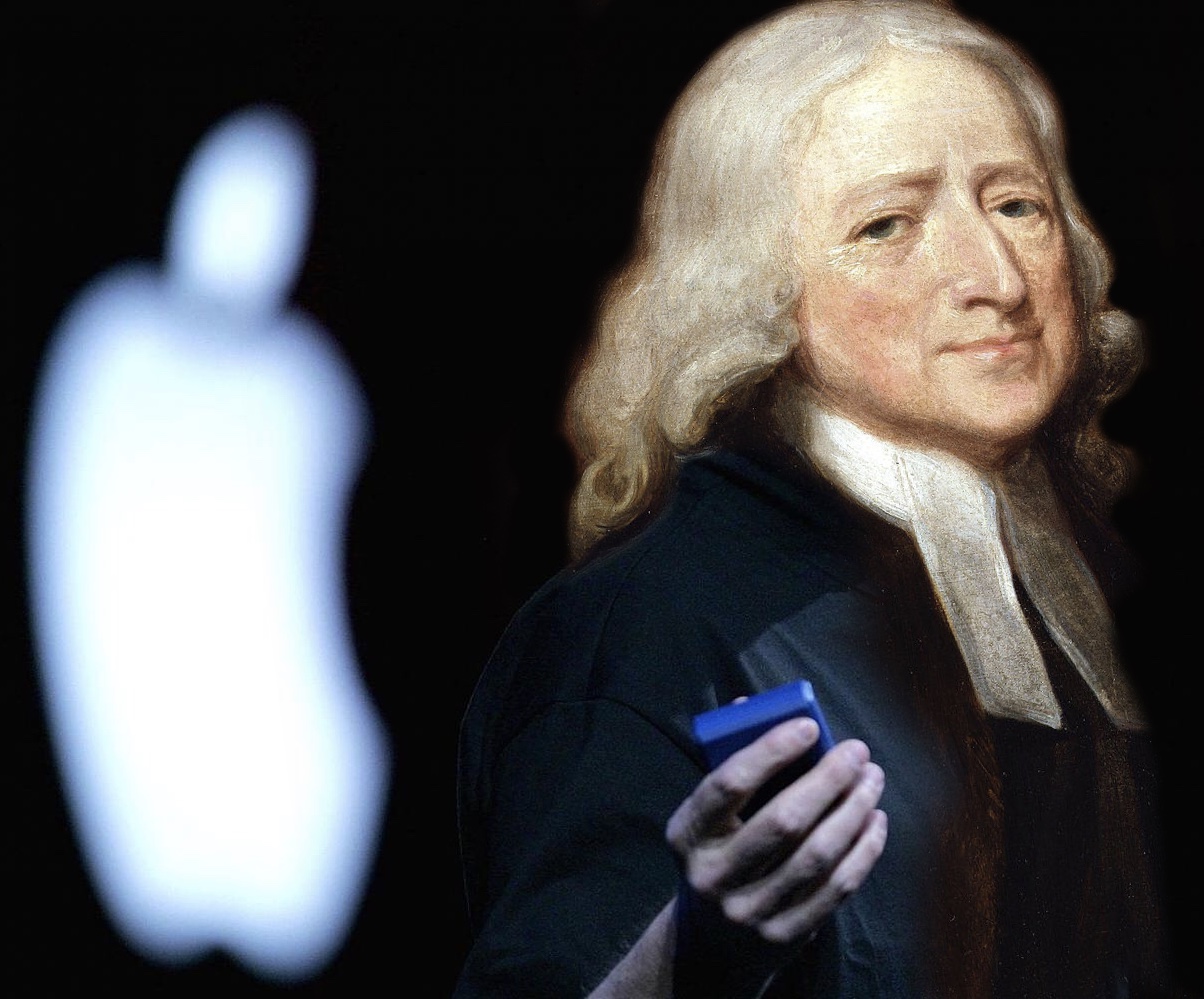
“Such an aspiration to monopolize the attention of believers was hardly abandoned after Christianity’s early days.  Some 1700 years later, John Wesley, the founder of Methodism, prescribed various means for keeping the mind attuned to God, such as the practice of thinking of him immediately upon waking, right before falling asleep, for at least an hour during the day, and before taking any important action.  (This discipline shares some similarity with the Jewish practice of offering brachot, or blessings, at various routine moments, such as before eating or drinking, or more exceptional ones, as when thunder is heard, among other practices codified in the Mishnah in the third century CE.)”

“To be sure, it isn’t as if before the twentieth century everyone was walking around thinking of God all the time.  Nevertheless, the Church was the one institution whose mission depended on galvanizing attention; and through its daily and weekly offices, as well as its sometimes central role in education, that is exactly what it managed to do.  At the dawn of the attention industries, then, religion was still, in a very real sense, the incumbent operation, the only large-scale human endeavor designed to capture attention and use it.  But over the twentieth century, organized religion, which had weathered the doubts raised by the Enlightenment, would prove vulnerable to other claims on and uses for attention.  Despite the promise of eternal life, faith in the West declined and has continued to do so, never faster than in the twenty-first century.  Offering new consolations and strange gods of their own, the commercial rivals for human attention must surely figure into this decline.  Attention, after all, is ultimately a zero-sum game.” (Pgs.26-27, The Attention Merchants, Tim Wu)

Translation?  The things we purchase, and technology/apps we use may be affordable or even free, but there is always a cost involved.  When that cost involves our attention during moments previously available to contemplation, quiet, prayer, & offering ourselves to discover the needs/desires/joys/pains of God & others – we may benefit from asking if we can/should really afford the price.

Question for conversation: Is it more redemptive to abstain from creating/posting content – helping spread subversive critique on consumption of social media, or to sparingly & creatively post content that points those who consume toward the Love and Truths of God?   How have you seen either – done well?

In any case – may we be people who invite our children & young people to think about these things.  May this be a year where we realize there are always prices unlisted.  May we seek redemptive ways to interact, create, and live together.  May we not be defined purely as amused consumers, or anxious responders, but discover new ways to offer Faith, Hope & Love creatively as New Creations ourselves…