Posted in Different Scriptures, Spoken Word

a poetic narrative for catechism…

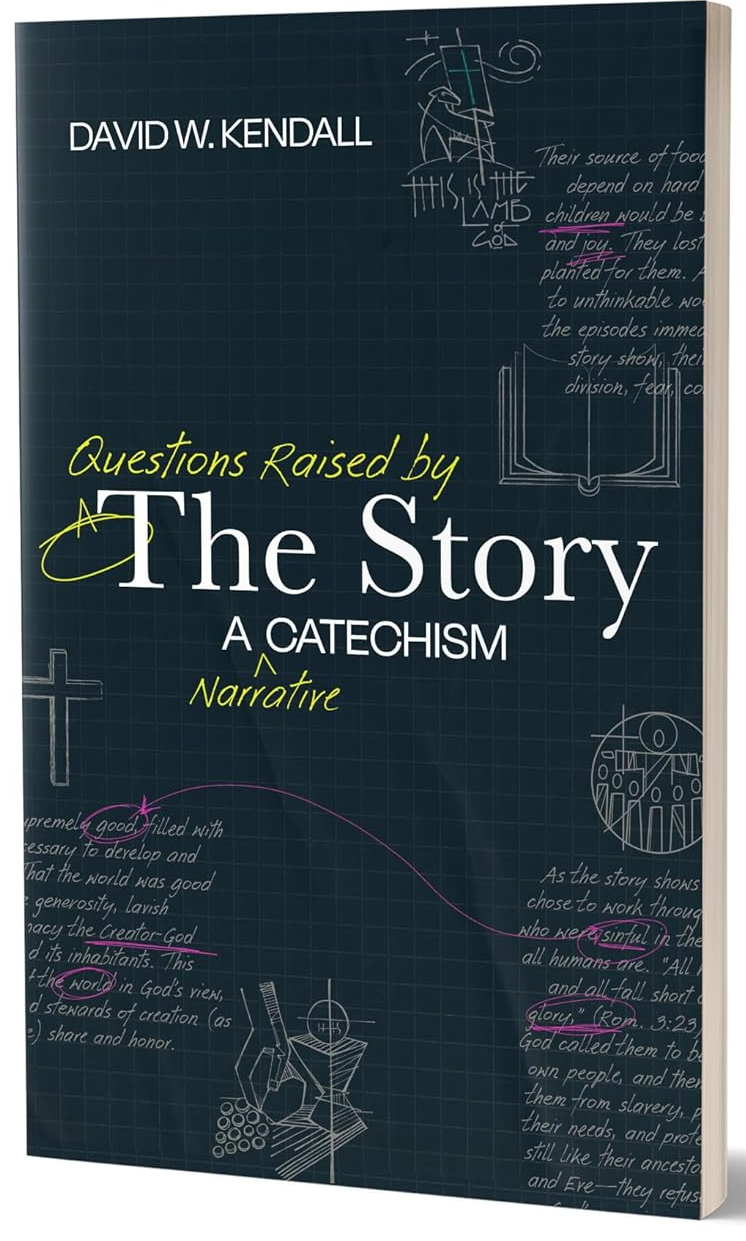
The following poem was written to be used (by both kids and grownups!) in conjunction with “Questions Raised by the Story: A Narrative Catechism“.  This helpful book (see the digital copy here!) offers a new approach to teaching important beliefs, presenting 61 questions inspired by “The Story” found in the Bible.  The lines connecting with particular questions are noted within the poem (ex: “Q1” means Question One, etc.)…

711ENc-hFaL._SL1500_

The Bible’s Story
(a poetic narrative that raises questions for catechism)

SCENE 1:
In the beginning, our God all created (Q1)
Ordered and shaped, and as Good (Q2)
Functional, but also abundantly fruitful
Ready to do what it should

All light and darkness, arriving on time
The land bringing forth all things growing
Creatures that swam, and crawling on ground (Q3)
His goodness abundantly showing

God placed all these things into our care
Female and male, Holy Civilization
Bearing His image, and knowing Him fully
To flourish and bless all creation (Q4, Q5, Q6)

SCENE 2:
All things were given, but we wanted more
Humanity turned from His way (Q7)
By eating the fruit He had forbidden
Our hearts from Him, began to stray (Q8, Q9)

No longer knowing God fully
We ceased also knowing each other (Q10)
Creation itself, filled with unknowns
Led even brother against brother (Q11)

Turning from God as source of all Life
We discovered sources of death
Humanity grew, so also our wounds
Which left us each gasping for breath

SCENE 3:
The heart of our God, the biggest heart, breaking (Q12)
The goodness He’d made, gone astray
He looked on His children, so hurting and sad
Not knowing any other way

So many voices, confusing and scattered
No one could hear from His heart (Q13)
Judgment through flooding, calming the waters
So God could offer a New start (Q14)

SCENE 4:
Our God, so Loving, could not give up hope
He knew His kids could be redeemed (Q15)
Calling a people to obey His Word
His Light through Israel streamed

Abraham, Isaac, and so many others
Those chosen, with whom God would dwell (Q16)
Through Loving them all dearly as His children (Q17)
And lifting them up when they fell

This way all people, could see God’s heart
Holy ways He designed us to live
In union with God, and with one another (Q18)
Receiving from all He would give (Q19)

SCENE 5:
The Lord’s Chosen People, broken and sinning (Q20)
Their hearts so often would stray
Receiving the promise, rescued from slavery (Q21, Q22)
Trusting Him along the way

They wandered in wilderness, with Moses leading (Q23)
The Lord gave commands made of stone (Q24)
Following God and the Way He revealed (Q25)
He would govern and give them a home (Q26, Q27, Q28)

Despite all the good that came from His Ways
The people still chose to rebel (Q29, Q30)
For their sake, God forced them in exile again
He could not pretend all was well (Q31, Q32)

SCENE 6:
God still so loved the people He’d made
All people, and all of creation
So God sent His Son, became human like us (Q33, Q34)
To bring our freedom and Salvation

Born into Israel, those who were chosen (Q35)
Jesus was Loving and healing
Walking the path God intended for all
The Kingdom of God now revealing (Q36, Q37)

Jesus declared, by His Words and Actions
The power of God had come here
Welcoming all, even those cast aside
Inviting them each to draw near

Draw near to the Father, and near each other
United in Love to abide (Q38, Q39)
They formed community of blessing for all
Revealing His arms open wide (Q40, Q41)

SCENE 7:
Jesus, the Cornerstone of coming Kingdom (Q42)
Both Son of God and of man
Revealed our broken condition before Him
Even those who knew of His plan (Q43)

For even knowing the desires of God
Was not enough to choose Right
Our hearts will always choose our own ways
In darkness, apart from His Light (Q44, Q45)

And so it happened, Jesus arrested
Accused and hung up on the cross
Dying because of those He had loved (Q46)
All Creation mourned such a loss

SCENE 8:
The Third Day, Jesus broke loose from the grave
Resurrected, He appeared to His friends (Q47)
An entirely brand New Creation appeared (Q48)
A New Story, as the old one ends

Just as we followed Moses before
Now Jesus, we follow anew (Q49)
Set free from sin, and its’ every impact
To His healing Kingdom pursue (Q50)

United in mission, He’s brought us together (Q51, Q52)
To spread Loves’ redeeming rebirth
Announcing the good news, He’s coming again
Along with New heavens and earth (Q53)

SCENE 9:
As His Resurrection people
Reflecting His image, our Lord (Q54)
Receiving His Spirit, and all He has done
As gifts we could never afford

Equipped, adopted sons and daughters (Q55)
Now serving with God in His ways
Caring for creation He is making New
Guiding all to abide in His grace (Q56)

We invite the world He is loving
To imagine what all might become
To be known fully, and fully Loved
By our Father, Holy Spirit, and Son (Q57, Q58, Q59, Q60, Q61)

Posted in Different Scriptures, Different Thoughts

a humbling season

With new “political seasons” starting pretty much weekly at this point, it’s always a good reminder for us to take a deep, slow breath. Unplug from the barrage of posts telling us what we should think about who. Locally, our church has been reminded recently that disciples of Jesus (especially in our political contexts) should be regularly growing in both hope and humility. As Paul left Ephesus in Acts 18:21, he obviously had hope in God using Priscilla & Aquila for the ministry there, but also had humility enough to know it didn’t depend on him staying to sustain the work.

Yes, we want to be those who engage the world with hope. Yes, we want to participate in justice coming, love transforming, and healing wounds both personal and systemic. But we are limited beings. At the end of our abilities, the moments where we have to leave, turn off the lights, or go to bed – we purposefully lay it at the feet of God – who has it all in His hands already. Some of us, without realizing it, believe that we cannot do what we see Paul doing here. News feeds tell us we have to stay plugged in for updates at any moment. Our push notifications draw us constantly out of being physically present with others in order to discover new details about something not in the room with us. We feel like unplugging from all these things might convey that we don’t care enough. We’ve been told to turn away from anything we care about, even for rest, is a betrayal. We feel like – if we don’t make a public statement, or send an email about every topic we care about – the important thing that should happen or be known might not happen or be known.

Here’s an important thing to tell yourself: I am not God. (say that with me)
You know what that means? We can unplug, and probably should often. We don’t have to comment on everything, to show others we know it all. You know what knowing it all is called? “Omniscient.” You know who is omniscient? God. We don’t have to have a presence on all the different apps – you know what that’s called? Omnipresence. You know who is omnipresent? God. You are not God. (say it again if needed) The more we feel like we need to know all things and be in all places, the more we are trying to be God.

Now this doesn’t mean we don’t care. We’re not stoics, who believe all things are predetermined and so we just do the best we can. We’re also not hippies that sing “If it’s meant to be, it’ll be, it’ll be.” (Sorry not sorry, Bebe.) Just like Paul, we dedicate ourselves to the task. We vote and get involved however we’re able to live out the prayers we offer. We sacrificially offer the resources available to us. We empower and trust others to do their part of the work that is much bigger than us.

Paul does end up coming back to Ephesus, by the way. You know how he gets there? It’s not by a magical tornado labeled “Will of God”. He chooses to travel there, and as we can read (Acts 19), he stays quite a while. Because he actually desires to be there. He leaves Ephesus in Acts 18:21 not saying “whatever happens, happens”. Saying “if God wills it” confesses that even in his deepest desires, he is still a limited being. Saying “if God wills it” does not abdicate our response-ability, but humbly confesses our limited nature. We do what we can, but we daily lay all things in the hands of our God who is working to accomplish His will.

There is peace found in this practice, worth incorporating such “laying things down” into our daily lives. But we may have to stop consuming new things long enough to do so…

ps. If you’re willing, make plans to join us & and entire Free Methodist Church USA as we pursue a month of Prayer and Fasting throughout September 2024. Check out their website to learn more!

Posted in Different Thoughts

important Free Methodist updates…

I’d recently shared these with others, and this seems like a great place to post some updates the Free Methodist Church has made to it’s most recent “Book of Discipline“. These give us important guidance on topics of capital punishment, the criminal justice system, and creation care. A few other updates were made, but I wanted to share these three specifically. (The links for each will direct you to the full text of the resolution, giving the background/Biblical foundations for each.) I’m thankful to be part of a global movement that continues to seek a faithful response as we pursue the arrival/revealing of Jesus’ Kingdom here and now by the power of His Spirit…

“The Free Methodist Church is deeply grieved when any life is taken by murder. We believe that persons who commit these or other horrendous crimes should be justly punished by just laws. Nevertheless, we believe that all human life is sacred, created by God, and therefore we must see all human life as significant and valuable. When governments implement the death penalty (capital punishment), then the life of the convicted person is devalued and all possibility of change in that person’s life ends. In well documented studies innocent people have become condemned and executed, in which cases a sentence meant to bring justice becomes an additional and irreversible form of injustice. For these reasons, the FMC deems the death penalty as currently applied to be inconsistent with our commitments to the sanctity of life.” (Pp. 3222 D)

“A criminal justice system plays an important role in securing peace and order for a society, protecting innocent people from harm, punishing wrongdoers, and delivering some semblance of justice for victims. Such systems, however, do not always perform these tasks justly. While victims of crimes ought to receive special moral attention, victimizers should receive fair treatment, and the opportunity to repent and be rehabilitated.
Although Free Methodists submit to the justice systems of their time and place, we do not unwittingly affirm their understanding of or approach to justice. Such systems should be in a continual process of review and revision toward achieving justice that is equitable and seeks the common good. We especially lament the ways in which such systems incarcerate, target, and treat particular demographics disproportionately. Free Methodists oppose any system that demeans, abuses, depersonalizes, or enslaves human beings, treating them as less than human. We are accordingly committed to justice systems that protect and defend victims of harm without violating the dignity of those punished. God is our Redeemer. It is not the job of the state to redeem those who commit crimes, but the state’s criminal justice system must conscientiously preserve space, time, and humane conditions for the restoration of all to human community. The church, including the Free Methodist Church, plays a central role in this restorative aspect of justice through our chaplains, local church ministries, and similarly focused ministries. Remembering that all people are created in the image of God and for fellowship with God, Free Methodists will actively pursue criminal justice system reforms that recognize and protect the dignity of all persons.” (Pp. 3221 D)

“The Lord God brings salvation to earth through a series of revealed covenants, culminating in the New Covenant in the blood of Jesus Christ. The first of these covenants, God’s covenant with the earth (Gen 9), is instituted following humanity’s fall into sin and after the flood. The rainbow is the visible sign of this covenant. God thus has an everlasting covenant with the earth (Gen 9:8-17), as well as His saving covenant with people. As God’s stewards on earth, called to “cultivate and care for it” (Gen. 2:15, NABRE), we affirm that God’s covenant with the earth constitutes our stewardship commission.
Therefore:
A. We affirm the goodness of God’s creation, the value—physical, emotional, social, and spiritual—of engagement with it, and our responsibility to care for it as an integral part of our Christian discipleship and God’s Creation mandate (Gen 2:15).
B. We lament the ways in which humanity has failed to fulfill these responsibilities, polluting our environment, damaging ecosystems, and harming other species. The consequences of such failures are borne the most by the poor and marginalized.
C. We affirm and seek to support effective ministries of creation care such as reducing our consumption, tree-planting and reforestation, sustainable agriculture and energy production, drought prevention and relief, environmentally sustainable transportation, appropriate recycling, and the minimization of waste.
D. We commit ourselves to be faithful stewards of God’s creation, engaging in practices that reflect God’s covenant with the earth and our commission to care for it, especially in our preaching, teaching, and spiritual practices; the sustainable stewardship of our church buildings and properties; global and local missions work and ministry; and civic efforts to care for our environment.
E. We, along with the whole of Creation, groan in anticipation of the time when “the creation itself will be liberated from its bondage to decay and brought into the freedom and glory of the children of God” (Rom 8:21). We eagerly look forward to the renewal of the whole of creation when God through the work of Jesus Christ finally “reconcile[s] to Himself all things, whether things on earth or things in heaven, by
making peace through His blood, shed on the cross” (Col 1:20).” (Pp. 3232)

Amen. 🙂