Posted in Different Learning, Different Scriptures, Uncategorized

do you mind?

What did you choose to wear today, or eat for lunch? Who did/will you choose to marry, or what did/will you choose as an occupation? Did you actually choose these things, or were you simply following a pattern pre-determined by the multifaceted details about the body/brain/family/time you were born and live within? You may or may not know – some neurologists have tried to make a case against “Free Will”. As a firm believer in the healing importance of confessing our agency, I want to offer a few thoughts on the conversation.

In Deuteronomy 30:19-20, we read “I call heaven and earth to witness against you today that I have set before you life and death, blessings and curses. Choose life so that you and your descendants may live, loving the Lord your God, obeying him, and holding fast to him, for that means life to you and length of days, so that you may live in the land that the Lord swore to give to your ancestors, to Abraham, to Isaac, and to Jacob.” We are given a choice. Similarly, in Galatians 5:16-17, “Live by the Spirit, I say, and do not gratify the desires of the flesh. For what the flesh desires is opposed to the Spirit, and what the Spirit desires is opposed to the flesh, for these are opposed to each other, to prevent you from doing what you want.” Even living as a follower of Jesus is not something we assume happens “automatically” when we believe, taking away our sense of agency. Paul writes imperatively, “live by the Spirit”, because there is the option to do otherwise.

So where does the questioning of “Free Will” come from? As highlighted well in the enjoyable book “The Unthinkable Truth“, the newest fMRI brainscan technology has pinpointed areas of our thought processes in ways we’ve never before had access to. Based on recent research, scientists can identify by a brain imaging what decision a person will make up to 10 seconds before a person is aware of their own decision being made. Which is interpreted as “The choice is made before the person consciously makes the choice.” As Bouskila writes in his fictional story around genuine research, “..the bottom line of all these studies is that between the two options – you control your brain or your brain controls you – the latter is correct.” Many believe these newest studies affirm what Benjamin Libet implied in his 1980’s experiments on the conscious free will. Our brains make decisions for us, before we are even aware of a choice being made.

Thankfully, even among those who are interpreting these things to mean we have less agency than once imagined, there is an openness to unpredictability. Recently, neuroscientist Robert Sapolsky has written, “Will we ever get to the point where our behavior is entirely predictable, given the deterministic gears grinding underneath? Never—that’s one of the points of chaoticism. But the rate at which we are accruing new insights into those gears is boggling—nearly every fact in this book was discovered in the last fifty years, probably half in the last five.

In the midst of all these things, our world is also watching the rise of artificial intelligence, and many are questioning the difference between a computer, and the human mind. Can consciousness be fabricated? If not fabricated, can it at least be transferred? Philosopher Christof Koch writes, “Computational functionalism is a widespread article of faith in Silicon Valley and the tech industry. From this point of view, the whole-brain simulation of your brain will possess your mind, or at least a fair approximation of it, and will be conscious. The integrated information theory of consciousness takes a starkly different approach. It argues that consciousness is not a type of computation but is fully and completely specified by the unfolded causal powers of the system upon itself, whether a brain or a computer.

Echoing Koch, neuroscientist Peter Ulric Tse reminds us our brains are not simply machines meant to do supercomputing. They are unique and non-reproducible, no matter how improved our “artificial intelligence” (which are mostly just Generative LLMs anyways) may become. As helpful as technology might be (ethics of regenerating using unique creative content aside), we have capacity as human beings that no machine will ever be capable of. This capacity is retained even with current debates of our “free will”. Tse writes, “..my journey into issues concerning the maximization of human liberty began with my efforts to escape the faulty metaphor of the brain as a computer, and place meaning rather than information at the center of what brains, minds, and consciousness are for.” Tse sees current research into calculating when a particular decision was made, and maintains that no matter when or how a decision is made, a foundation of our humanity is our creative freedom and imagination. He writes, “We can strive to become a self that we imagine, thereby choosing to become a new kind of chooser operating in a new kind of world of our own choosing.

All of this echoes recent writing by Jim Wilder in his book “Renovated”, where he takes some familiar content by Dallas Willard and makes new contributions toward the healing transformation God desires through attachment. Many people find it difficult to “become a Christian” by simply adopting new beliefs or assenting to a particular new Truth. I believe this is why God has invited us to experience healing (often called “salvation”, in the eternal sense) in an intentional community (Church) of loving relationships, and in loving relationship with our Triune God. Wilder writes, “The ability to choose (will) is a very flimsy cortical function located on the outside of our brain…attachments (relational identity), at a brain level (beginning in the brain stem) create an identity that operates faster than conscious thought.” To put it simply, as others have written, “We are transformed more by what we love, than what we think.”

All of this is to say, as new research might emerge about when our brains decide something, or what computers might be capable of – remember that you are uniquely able to exist as you today. You are capable not only of sensing, but of discovering the meaning behind what you sense, and the mutual accountability of discovering that meaning with others. You are capable not only of deciding based on what you see, but based on the future realities you’re able to imagine prayerfully together with the Holy Spirit. You’re invited to confess the choices you had agency in making (James 5:16), repent (turning away & having a changed mind), being set free from past narratives by the authority of Jesus, so that together in a community of beloved others, we can collectively experience healing restoration and transformation toward a New Creation God has already begun in the resurrected Jesus Christ.

This is literally the super-natural becoming our new natural. I am thankful for the healing that has come already, and looking forward to how His healing continues to arrive personally, communally, and universally.
Posted in Different Scriptures, Spoken Word

a poetic narrative for catechism…

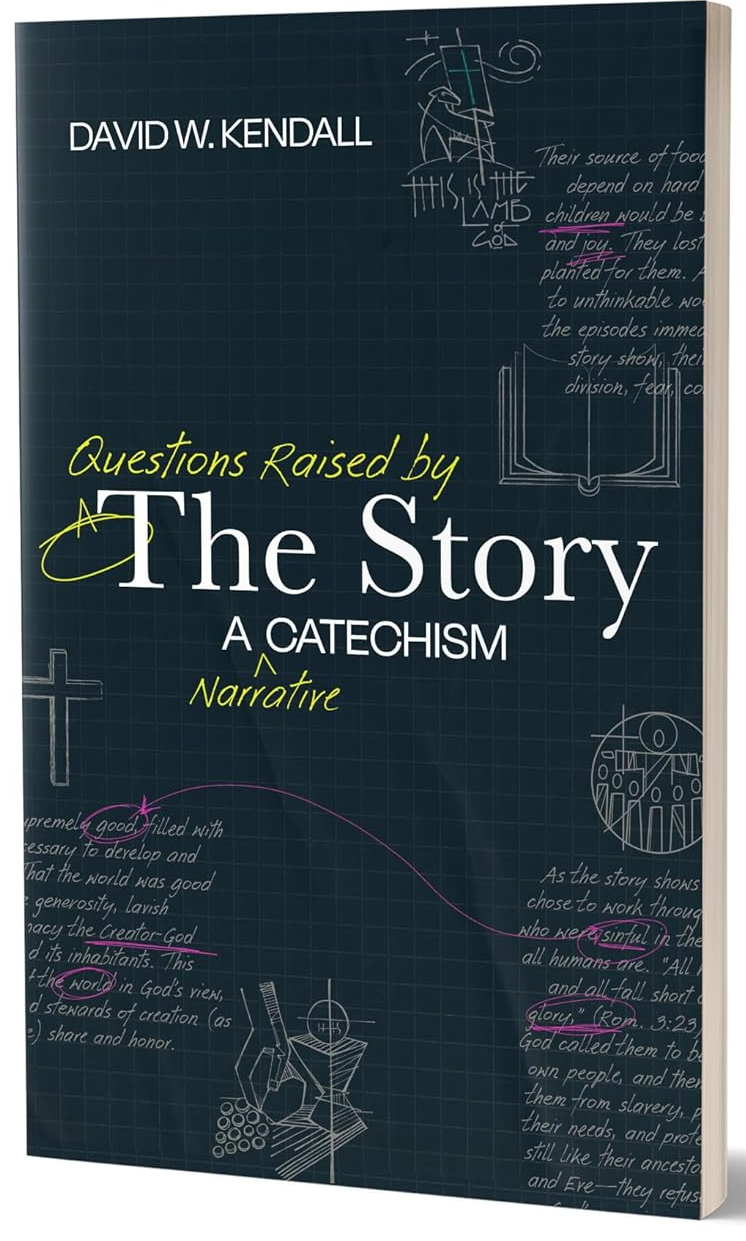
The following poem was written to be used (by both kids and grownups!) in conjunction with “Questions Raised by the Story: A Narrative Catechism“.  This helpful book offers a new approach to teaching important beliefs, presenting 61 questions inspired by “The Story” found in the Bible.  The lines connecting with particular questions are noted within the poem (ex: “Q1” means Question One, etc.)…

711ENc-hFaL._SL1500_

The Bible’s Story
(a poetic narrative that raises questions for catechism)

SCENE 1:
In the beginning, our God all created (Q1)
Ordered and shaped, and as Good (Q2)
Functional, but also abundantly fruitful
Ready to do what it should

All light and darkness, arriving on time
The land bringing forth all things growing
Creatures that swam, and crawling on ground (Q3)
His goodness abundantly showing

God placed all these things into our care
Female and male, Holy Civilization
Bearing His image, and knowing Him fully
To flourish and bless all creation (Q4, Q5, Q6)

SCENE 2:
All things were given, but we wanted more
Humanity turned from His way (Q7)
By eating the fruit He had forbidden
Our hearts from Him, began to stray (Q8, Q9)

No longer knowing God fully
We ceased also knowing each other (Q10)
Creation itself, filled with unknowns
Led even brother against brother (Q11)

Turning from God as source of all Life
We discovered sources of death
Humanity grew, so also our wounds
Which left us each gasping for breath

SCENE 3:
The heart of our God, the biggest heart, breaking (Q12)
The goodness He’d made, gone astray
He looked on His children, so hurting and sad
Not knowing any other way

So many voices, confusing and scattered
No one could hear from His heart (Q13)
Judgment through flooding, calming the waters
So God could offer a New start (Q14)

SCENE 4:
Our God, so Loving, could not give up hope
He knew His kids could be redeemed (Q15)
Calling a people to obey His Word
His Light through Israel streamed

Abraham, Isaac, and so many others
Those chosen, with whom God would dwell (Q16)
Through Loving them all dearly as His children (Q17)
And lifting them up when they fell

This way all people, could see God’s heart
Holy ways He designed us to live
In union with God, and with one another (Q18)
Receiving from all He would give (Q19)

SCENE 5:
The Lord’s Chosen People, broken and sinning (Q20)
Their hearts so often would stray
Receiving the promise, rescued from slavery (Q21, Q22)
Trusting Him along the way

They wandered in wilderness, with Moses leading (Q23)
The Lord gave commands made of stone (Q24)
Following God and the Way He revealed (Q25)
He would govern and give them a home (Q26, Q27, Q28)

Despite all the good that came from His Ways
The people still chose to rebel (Q29, Q30)
For their sake, God forced them in exile again
He could not pretend all was well (Q31, Q32)

SCENE 6:
God still so loved the people He’d made
All people, and all of creation
So God sent His Son, became human like us (Q33, Q34)
To bring our freedom and Salvation

Born into Israel, those who were chosen (Q35)
Jesus was Loving and healing
Walking the path God intended for all
The Kingdom of God now revealing (Q36, Q37)

Jesus declared, by His Words and Actions
The power of God had come here
Welcoming all, even those cast aside
Inviting them each to draw near

Draw near to the Father, and near each other
United in Love to abide (Q38, Q39)
They formed community of blessing for all
Revealing His arms open wide (Q40, Q41)

SCENE 7:
Jesus, the Cornerstone of coming Kingdom (Q42)
Both Son of God and of man
Revealed our broken condition before Him
Even those who knew of His plan (Q43)

For even knowing the desires of God
Was not enough to choose Right
Our hearts will always choose our own ways
In darkness, apart from His Light (Q44, Q45)

And so it happened, Jesus arrested
Accused and hung up on the cross
Dying because of those He had loved (Q46)
All Creation mourned such a loss

SCENE 8:
The Third Day, Jesus broke loose from the grave
Resurrected, He appeared to His friends (Q47)
An entirely brand New Creation appeared (Q48)
A New Story, as the old one ends

Just as we followed Moses before
Now Jesus, we follow anew (Q49)
Set free from sin, and its’ every impact
To His healing Kingdom pursue (Q50)

United in mission, He’s brought us together (Q51, Q52)
To spread Loves’ redeeming rebirth
Announcing the good news, He’s coming again
Along with New heavens and earth (Q53)

SCENE 9:
As His Resurrection people
Reflecting His image, our Lord (Q54)
Receiving His Spirit, and all He has done
As gifts we could never afford

Equipped, adopted sons and daughters (Q55)
Now serving with God in His ways
Caring for creation He is making New
Guiding all to abide in His grace (Q56)

We invite the world He is loving
To imagine what all might become
To be known fully, and fully Loved
By our Father, Holy Spirit, and Son (Q57, Q58, Q59, Q60, Q61)

Posted in Different Thoughts, Uncategorized

A Woman of Prayer

Sometime in the early-middle of my serving as one of the pastors in Decatur, Illinois, there was a woman who impressed me in the area of prayer. We were hosting an “All Night Prayer” at Moundford Free Methodist Church. We weren’t a giant congregation, and many people had other commitments, families to care for, or work that prevented them from coming. But we knew it was important, and so planned to spend most of the night in the sanctuary, or walking from room to room praying over the ministry that happened there and the lives/homes of those involved as they came to mind.

Confession: I’m a morning person. When I stay up late, I drift off easily unless I’m doing something active or with a lot of people. Suffice to say, I was challenged by my abilities to stay awake around 11:30pm as we slowly walked through the church, saying and whispering prayers that came to mind. Yet in the midst of these things, I was challenged all night long by the presence of this older woman, Velva, who was almost 100 years old and seemed like she’d just drank 2 Red Bulls of prayer. She had obviously drank deeply from the wells of God’s Love, and was living from a continued gratitude for all He had done in her life – and an urgent heart that wanted her family and friends to know this same hope and love she’d discovered.

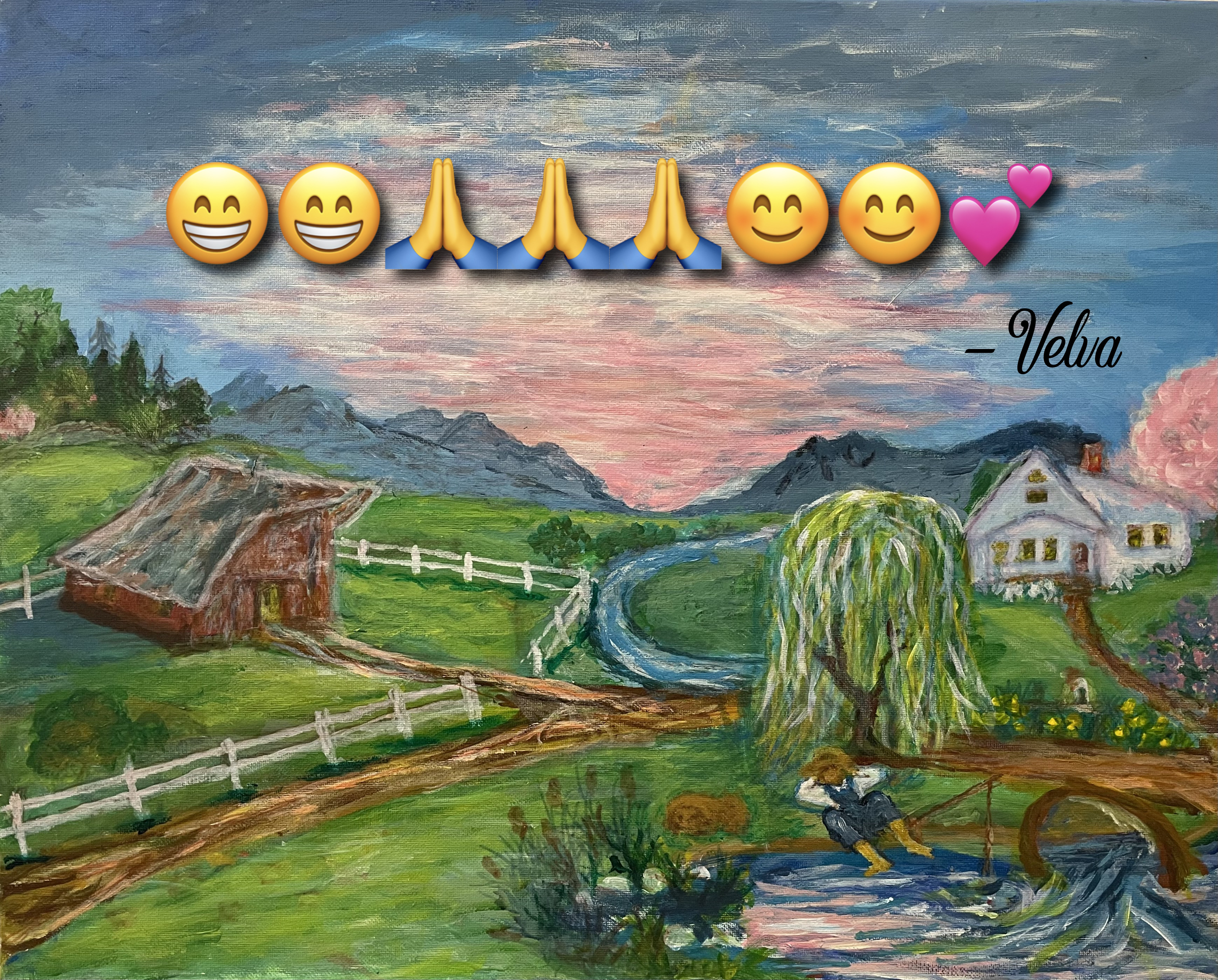
As the years went forward, her heart and prayers never abated. Even when she stopped leaving her home as much, she would text me her prayers once in a while. She prayed for our family as we fought to bring our daughter home from the DRC. She prayed for our family as we decided to become missionaries. I remember visiting her not long after we made that decision, with our daughters at her home. She prayed with us, told us how much she loved Jesus, and showed us some of her paintings. She was not only an artist, she was worshiping actively by connecting to the creative heart of her creator. It was obvious that she had tapped into deep wells of His Love and life, and it just oozed out of her whenever you were able to connect.

At one point, she asked if she could paint a specific scene for us – and what we might want. Sarah and I thought for a while, and then described the kind of scene we’d love to have her put onto canvas for us. It wasn’t long before she messaged that her artwork was ready, and we should come pick it up. Of course it’s beautiful, inspiring, and very much as we’d described to her. On the back, she’d even written for us to remember “From Velva….Age 103”. What a beautiful gift, and it hangs in my office today.

Velva’s painting, along with the final text message she’d sent me.

As we went to Hungary, I made sure she understood we could still keep in touch. She would text me (thanks iMessage, for helping people stay connected on the other side of the world easily!) and ask how the ministry was going, how the family was doing, or just to tell me she was praying for my “sweet family”. I would try to send her pictures of natural beauty that reminded me of the nature scenes she painted. We both agreed – His creation was beautiful, and deserved to be paid attention to.

I never knew when her text messages might arrive, especially when we lived in Hungary. Because of the time difference, sometimes they’d arrive in the middle of the night for me. But I always smiled when I’d check my phone, and see all the heart emojis, praying hand emojis, and a few words to remind me our family was in her prayers, and asking me to affirm, “Isn’t the Lord good??” Yes, He is good, and His Love endures forever. Our frail human bodies, however, do not. It didn’t seem like it could ever happen, but on February 25th, 2023, Velva finally went home to be with Jesus fully. Now she is with the Father, waiting for the completion of all He has in store at New Creation.

I am so thankful for Velva. For her prayers, and for the ways she encouraged and loved our family – even from a distance. I want to encourage you – reach out to your missionaries, your overseas friends, and the people who come to your mind and heart. It doesn’t take much – just a few emoji’s and a reminder “You’re in my prayers today. Remember you are loved.” Know that you are loved yourself as well, and take a moment to notice the beauty of God’s creation – even if it takes a while to find it. It’s worth noticing.

I smile, imagining that perhaps God would hand Velva the paintbrush for some grand sunset, and whisper “Here…you do this one…”